 English
New York Paycheck Calculator 2026 – Calculate Your Take-Home Pay
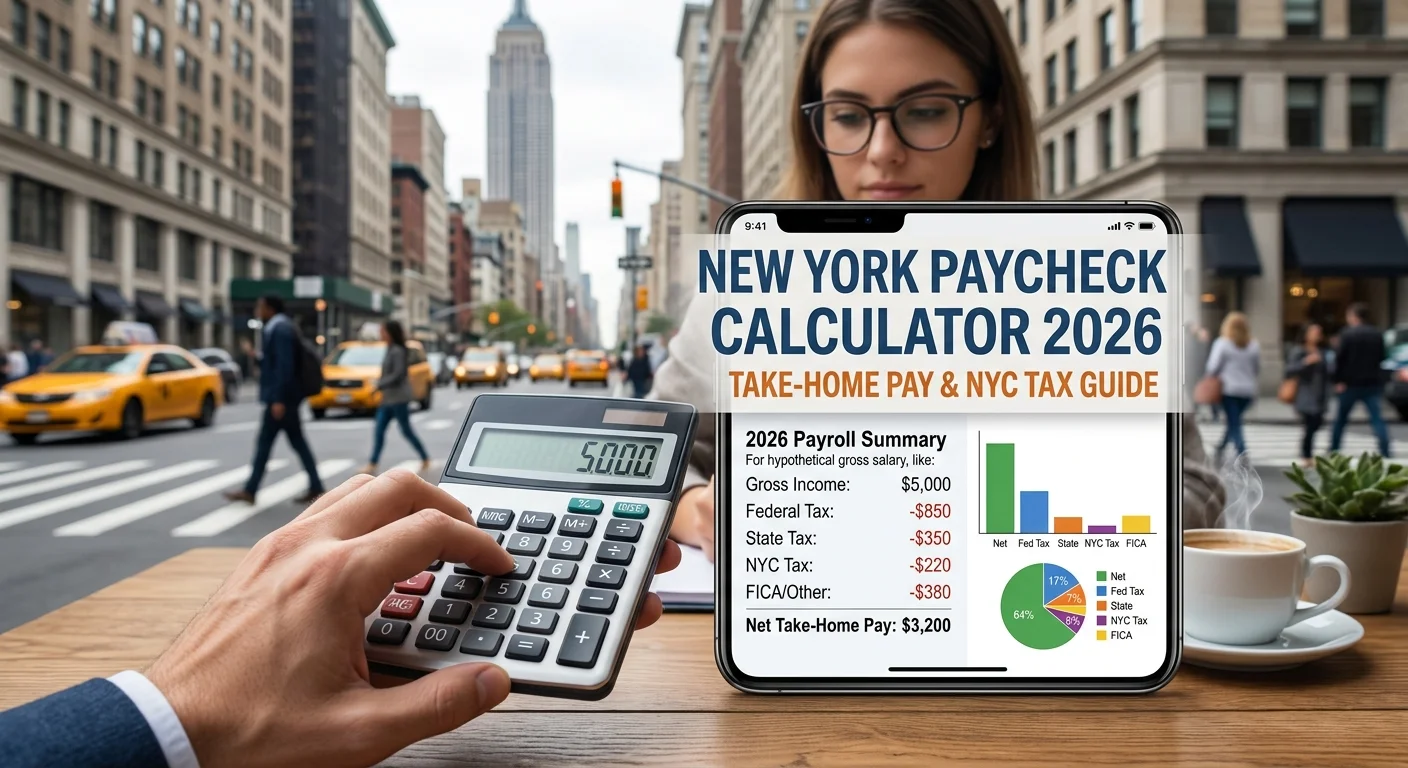
If you work in New York, your paycheck goes through more layers than almost anywhere else in the country. On top of federal tax and FICA, New York State takes its own bite — and if you live or work in New York City or Yonkers, there's a third layer of local income tax that a lot of general paycheck calculators quietly skip.
This guide walks through exactly how a New York paycheck is built, what makes it different from states like Texas or California, and how to use the Salary Paycheck Calculator to get a realistic estimate — including where you need to account for NYC or Yonkers tax yourself.
Quick Answer
A New York paycheck is reduced by four to five layers depending on where you live and work: federal income tax withholding, Social Security, Medicare, New York State income tax, and — for New York City or Yonkers residents — local income tax on top of that. New York also funds Paid Family Leave through a small employee payroll deduction. There is no single percentage that applies to everyone; the actual amount depends on your salary, filing status, W-4 elections, and where you live.
What Makes a New York Paycheck Different
Compare New York to two very different states:
- Texas has no individual state income tax at all. A Texas paycheck's only real tax layers are federal and FICA.
- California has a progressive state income tax plus State Disability Insurance (SDI), but no separate city-level income tax layered on top for most residents.
- New York has a progressive state income tax and, uniquely among the largest states, a genuinely separate local income tax for anyone who lives in New York City or Yonkers — regardless of whether they work there.
That local layer is the single biggest reason a New York City resident's paycheck can look meaningfully different from a paycheck for someone earning the same salary in, say, Buffalo or Albany, even though both are "New York" employees for state tax purposes.
New York State Income Tax
New York uses a progressive income tax with multiple brackets rather than one flat rate. For the 2026 tax year, New York's state legislature reduced several of the lower bracket rates as part of its enacted budget, continuing a phase-in that began the prior year. The state's official withholding tables — published by the New York State Department of Taxation and Finance as Publication NYS-50-T-NYS — set out exactly how much employers should withhold based on your wages, filing status, and pay frequency.
The practical takeaways for a paycheck:
- The more you earn, the higher the marginal rate on your top slice of income, but every dollar isn't taxed at your top rate — only the portion that falls into each bracket.
- Your New York withholding is calculated separately from your federal withholding and from FICA. They don't offset each other.
- Employees complete a state-specific withholding form, Form IT-2104, in addition to the federal Form W-4, and the choices on that form directly affect how much state tax is withheld from each check.
Because bracket thresholds and rates can change from year to year, always check the current New York State Department of Taxation and Finance withholding tables rather than relying on a number you saw in a previous tax year.
New York City and Yonkers: The Layer Most Calculators Miss
This is the part of a New York paycheck that catches people off guard.
If you are a New York City resident, you owe New York City resident income tax in addition to New York State income tax — even if you work outside the five boroughs. If you are a Yonkers resident, a similar local tax applies. Nonresidents who merely work in NYC do not pay the NYC resident tax, but Yonkers does apply a smaller nonresident earnings tax to people who work there without living there.
This local tax is calculated on top of your state taxable income using its own rate schedule — it is not a slice carved out of the state tax you already paid. That's exactly why the Salary Paycheck Calculator explicitly notes that local, city, and county income taxes are not included unless specifically modeled for the selected location. When you select New York in the tool, you're getting an accurate federal, FICA, and New York state estimate — but if you live in NYC or Yonkers, you should mentally set aside room for that additional city-level withholding, since it isn't folded into the state estimate.
If you're comparing a job offer inside NYC against one outside the city, or against a move to a no-tax state, this is the single most important line item to research directly with your employer's payroll department or the NYC Department of Finance, because it can change your real take-home pay by a noticeable margin.
Social Security and Medicare (FICA) — Same Rules as Everywhere Else
FICA doesn't care what state you live in. For 2026:
| Tax | Employee rate | 2026 limit |
|---|---|---|
| Social Security | 6.2% | Up to $184,500 of wages |
| Medicare | 1.45% | No cap |
| Additional Medicare | 0.9% | On wages above $200,000 (single) |
Once your year-to-date wages cross $184,500, Social Security withholding stops for the rest of the calendar year — but Medicare keeps applying to every dollar you earn, with no ceiling.
New York Paid Family Leave (PFL)
New York funds its Paid Family Leave program through a small, mandatory employee payroll deduction — similar in spirit to California's SDI, but a different program with its own rate. For 2026, the employee contribution rate is 0.432% of gross wages per pay period, capped at a maximum annual employee contribution of $411.91. Unlike Social Security, this cap is based on the statewide average weekly wage rather than your individual salary, so most employees will see the same 0.432% deducted on every paycheck until they hit that annual cap.
PFL provides paid, job-protected leave for bonding with a new child, caring for a family member with a serious health condition, or certain military-family situations. It shows up on a New York pay stub as its own line item, separate from state income tax — which is exactly how the Salary Paycheck Calculator's "State Payroll Taxes" section is designed to display state-specific payroll taxes when a state has them.
Gross Pay vs. Net Pay: A New York Example
Let's walk through a hypothetical New York employee to make this concrete.
Assumptions:
- Annual salary: $90,000
- Pay frequency: Biweekly (26 paychecks per year)
- Filing status: Single, no dependents, standard W-4 (no extra adjustments)
- Lives and works outside New York City (no local tax in this example)
- No pre-tax or post-tax deductions
Step 1 — Gross pay per paycheck
$90,000 ÷ 26 = $3,461.54 gross biweekly pay
Step 2 — What comes out
From that $3,461.54, the paycheck is reduced by:
- Federal income tax withholding (based on the IRS Pub 15-T percentage method and this employee's W-4)
- Social Security: 6.2% of $3,461.54 = $214.62
- Medicare: 1.45% of $3,461.54 = $50.19
- New York State income tax withholding (based on IT-2104 and the current NYS-50-T-NYS tables)
- New York Paid Family Leave: 0.432% of $3,461.54 ≈ $14.95 (until the annual cap is reached)
Step 3 — Net pay
The exact federal and state withholding numbers depend on this employee's specific W-4 and IT-2104 elections, which is exactly why a calculator that applies the current percentage-method tables — rather than a flat guess — matters. Enter this same salary, frequency, and filing status into the Salary Paycheck Calculator with New York selected as the state, and it will apply the current federal and New York withholding tables automatically and show you the complete breakdown, including the FICA and PFL amounts calculated above.
Now change one thing: select a New York City address on your actual pay stub, and expect an additional local tax line the calculator's state-only estimate won't include — budget for it separately using your employer's payroll department or the NYC Department of Finance's current rate information.
Pay Frequency in New York
New York doesn't change how pay frequency works — the same four common schedules apply as anywhere else:
| Frequency | Pay periods per year |
|---|---|
| Weekly | 52 |
| Biweekly | 26 |
| Semimonthly | 24 |
| Monthly | 12 |
Your annual gross pay, annual tax liability, and annual net pay are the same regardless of frequency — only the size of each individual check changes. A biweekly schedule (26 paychecks) is easy to confuse with semimonthly (24 paychecks); if your employer pays "twice a month" on fixed dates like the 15th and last day of the month, that's semimonthly, not biweekly, even though people often use the terms loosely.
Factors That Can Change Your New York Take-Home Pay
Beyond the base calculation, several things commonly shift a New York paycheck from one period to the next:
- A raise, bonus, or commission payment (bonuses are frequently withheld using a different federal method than regular wages)
- Updating your federal Form W-4 or state Form IT-2104
- Starting or changing 401(k), HSA, FSA, or health insurance elections
- Moving into or out of New York City or Yonkers, which adds or removes the local tax layer
- Crossing the Social Security wage base partway through the year, which stops that specific withholding for the rest of the year
- Year-over-year changes to New York's state bracket rates or the PFL contribution rate, both of which are adjusted periodically
How to Use the Salary Paycheck Calculator for New York
- Choose Annual Salary or Hourly Rate, then select your pay frequency (weekly, biweekly, semimonthly, or monthly).
- Select New York from the state dropdown, choose your federal filing status, and enter any dependents or W-4 adjustments that apply to you.
- Add any pre-tax deductions (401(k), HSA, FSA, health insurance) and post-tax deductions you have, then click Calculate.
- Review the full breakdown: federal withholding, Social Security, Medicare, New York state income tax, New York state payroll taxes (including PFL, where modeled), and your resulting net pay per paycheck and per year.
- If you live in NYC or Yonkers, treat the result as your state-level estimate and separately account for local income tax, since the tool explicitly does not include city/county tax unless specifically modeled for your selection.
Frequently Asked Questions
Does New York have state income tax?
Yes. New York uses a progressive state income tax with multiple brackets, meaning higher earners pay a higher marginal rate on their top slice of income. This is withheld from every paycheck based on your Form IT-2104 elections and current New York withholding tables.
Does the calculator include New York City tax?
The Salary Paycheck Calculator applies New York's state income tax rules when you select New York. Local and city income taxes, including New York City and Yonkers resident tax, are not included unless specifically modeled for the selected location — so NYC or Yonkers residents should budget separately for that additional local withholding.
What is New York Paid Family Leave on my paycheck?
It's a mandatory employee-funded payroll deduction — 0.432% of gross wages per pay period for 2026, capped at a maximum annual contribution of $411.91 — that funds New York's Paid Family Leave program, which provides paid, job-protected leave for qualifying family and medical situations.
How much is taken out of a paycheck in New York?
There's no single percentage that applies to everyone. It depends on your salary, filing status, federal and state W-4/IT-2104 elections, and whether you live in a locality with its own income tax. Federal withholding, Social Security, Medicare, New York state income tax, and PFL are the layers that generally apply to most New York employees.
Are Social Security and Medicare different from New York state tax?
Yes. Social Security and Medicare are federal payroll taxes that apply the same way regardless of which state you work in. New York state income tax and Paid Family Leave are calculated separately, under New York's own rules.
Is a New York paycheck calculator exact?
No calculator can guarantee the exact figure on your employer-issued pay stub. Results are estimates based on the information entered and the tax rules built into the tool. Your actual paycheck can differ because of local taxes not modeled in a state-level estimate, employer payroll settings, benefits, supplemental wage withholding, and your individual W-4/IT-2104 elections.
Calculate Your New York Take-Home Pay
Your salary tells you what you're paid before taxes — not what actually lands in your bank account. Between federal withholding, FICA, New York state tax, Paid Family Leave, and (for NYC or Yonkers residents) local tax, a New York paycheck has more moving parts than most.
Use the Salary Paycheck Calculator to enter your New York salary or hourly pay, filing status, and deductions, and see your estimated federal, FICA, and state tax breakdown side by side. If you're weighing a move, it's also worth comparing against a no-tax state like our Texas Paycheck Calculator guide, or another high-tax state via our California Paycheck Calculator guide, to see how the same salary plays out differently depending on where you work.
Disclaimer: This calculator and article provide estimates for informational purposes only. Actual paycheck amounts may vary based on your specific tax situation, withholding elections, local tax obligations, benefits, deductions, and other individual factors. This content does not constitute tax, legal, or payroll advice — for decisions about your actual taxes, consult a qualified tax professional or the relevant government agency.
Official Tax Resources
- IRS Publication 15-T — Federal Income Tax Withholding Methods
- IRS Publication 15 — Employer's Tax Guide
- New York State Department of Taxation and Finance — Withholding Tax Rate Changes
- New York State Department of Financial Services — Paid Family Leave Rate Decisions
- Social Security Administration — Contribution and Benefit Base
- IRS Tax Withholding Estimator